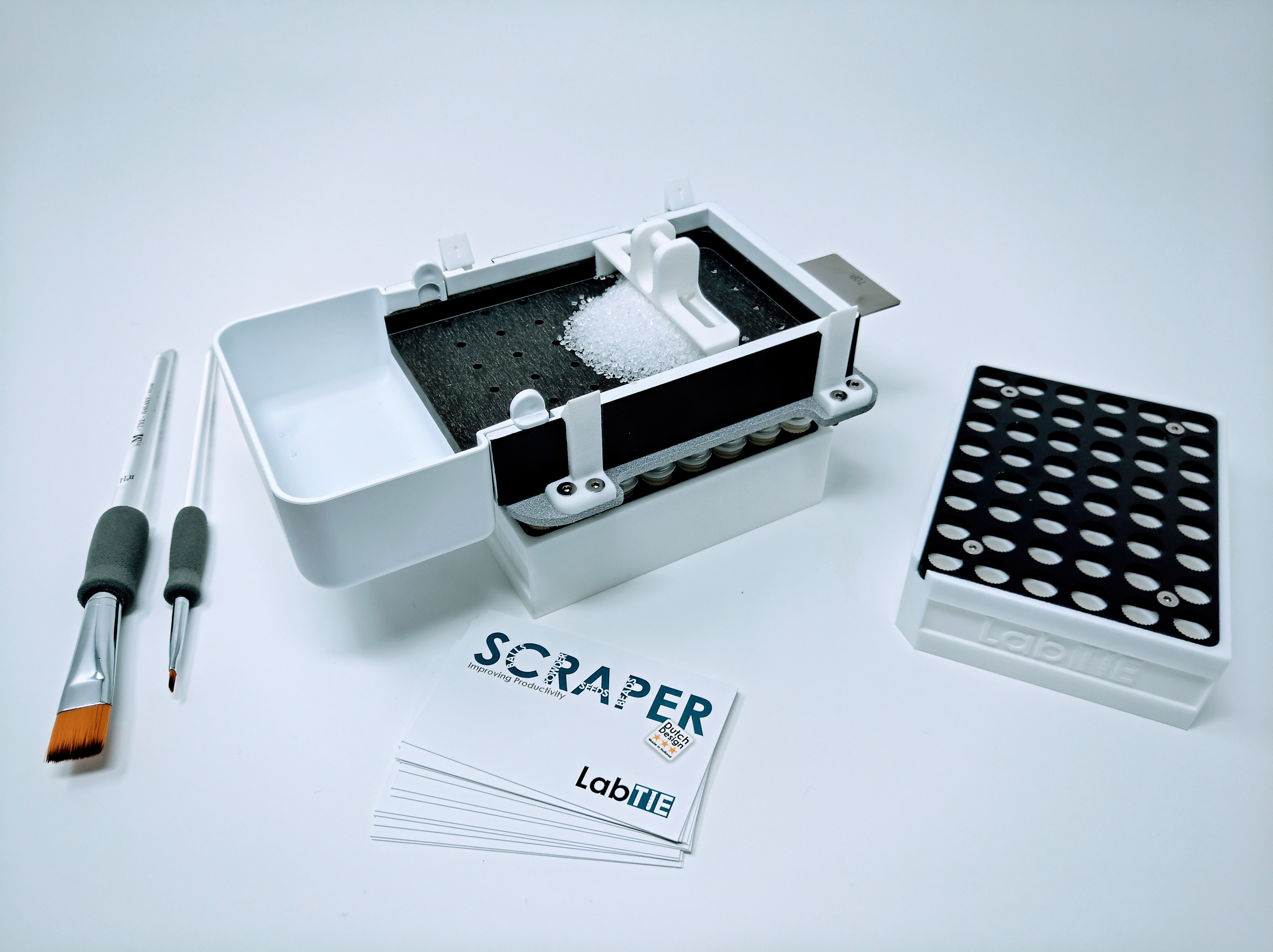
Consistent bead beating starts with how you load the beads
Bead beating is only as even as the beads you start with. If some wells get a pile and others just a few, lysis drifts, and so do your DNA and RNA yields. A manual bead dispenser loads a full plate of grinding beads in one move, so every well reaches the homogenizer with the same charge.
At a glance. Loads a full plate or tube rack of grinding beads in one action. One measured charge per well, set by the mesh plate. Formats from 24 well to 384 well, plus tube racks.
The tool is manual, so it drops into a protocol you already run. There is no software to learn and nothing to calibrate, and it works alongside the bead mill and extraction kit on your bench today.
How it works
The dispenser holds a mesh plate sized to your beads. You load beads across the plate, tilt it so the excess rolls off into a bucket, then release. One bead, or one measured charge, drops into every well or tube at the same moment. To match a different bead size or a different plate, you swap the mesh plate rather than the whole tool.

Why the bead load decides the result
In bead beating the beads do the mechanical work of breaking open cells, tissue, seeds or microbes. Too few beads and lysis is incomplete. Too many and you waste beads and heat the sample. Loading by scoop or by eye is where a lot of well to well variation creeps in, and it only shows up later as uneven yields that are hard to trace.

One tool, many formats
Most labs run more than one plate type, so the dispenser is built around interchangeable mesh plates.
| Format | Typical use | How the dose is set |
|---|---|---|
| 24 well | Larger samples and deep well plates | Swap the mesh plate |
| 96 well | Routine DNA and RNA extraction | Swap the mesh plate |
| 384 well | High throughput genotyping | Swap the mesh plate |
| 45 tube | 45 position snap cap tube racks | Swap the mesh plate |
| Tubes and racks | Individual sample tubes | Matching mesh plate |

Where it fits in the workflow
Bead loading sits right before homogenization in a DNA or RNA extraction workflow. It is used in molecular diagnostics, microbiology, plant and seed genomics and general life science labs, wherever reproducible lysis is the foundation of a clean extraction.
What it will not do
It is a manual tool, so it will not slot into a fully robotic line, and it is built to give the same charge to every well rather than a custom amount in each. If you need a different bead load per well, you are back to weighing. If you need the same clean load across a full plate, every time, it is hard to beat on speed.
Try it with your own samples
The real test is your own samples and your own beads. If bead loading is a bottleneck or a source of variation in your lab, get in touch and we will talk through the plates, tubes and grinding media you work with.
Leave a Reply